Stellar Energy
Stellar energy is not as we have been led to believe by academia.
Institutional Dogma
Institutional claims regarding stellar energy are impossible. Think about it …
a) It is claimed that our sun's energy comes from fusion.
Fusion is a one-time (instantaneous) release of energy. It does not generate continuous energy. So, it should not be radiating energy today.
Fusion energy can only occur naturally through core pressure, so, our sun would only be able to generate continuous fusion energy if it continually (and substantially) increased its mass, which is not the case.
b) It is claimed that stellar fusion converts hydrogen to helium; i.e. our sun comprises helium.
The density of liquid helium is about 187 kg/m³ and its boiling point is 4.22 K, whereas the sun's surface temperature is 5788 K; its core would of course be higher. NASA guesses that the sun's core temperature is 15,000,000 °C. This must mean that the sun comprises helium gas, which is considerably less than 187 kg/m³, yet our sun's average density is; ρₛ = 1409.782932 kg/m³.
The sun's known density, NASA's guesswork, and documented density and boiling temperature of helium cannot be reconciled with the known properties of our sun.
c) It is claimed that our sun is created by fusing hydrogen atoms into helium atoms.
According to PVRT, @ the sun's core temperature (Ṯₙ):
The pressure of hydrogen; p₁ = 7.320744E+08 N/m² and helium; p₂ = 3.848950E+09 N/m² and δp = p₂-p₁ = 3.116876E+09 N/m²
The pressure at the core of the sun at a density of ρₛ;
p = ρₛ.(hₑ/d)² = 1.228163E+09 N/m² (where d = inter-atomic spacing of liquid helium)
So, it is impossible to achieve the pressure necessary for fusion from hydrogen to helium at the core of our sun according to the universally accepted PVRT formula.
d) It is claimed that our sun's energy is generated by fusing hydrogen atoms into helium atoms.
However, all hydrogen atoms are electrically positive. Positive charges repel. So, what force can generate this fusion. It cannot be gravitational, because gravitational energy is 4.40742111792334E-40 times that of electrical repulsion energy (the coupling ratio; φ).
e) It is claimed that stars expand with age and their energy comes from fusion.
These claims are contradictory; fusion increases density, decreasing volume (size).
The density of liquid hydrogen; ρ₁ = 70.9 kg/m³ and the density of liquid helium; ρ₂ = 187 kg/m³
The atomic volume of liquid hydrogen is; V₁ = 4.739567E-29 m³ and helium is; V₂ = 3.582077E-29 m³
Which means that our sun should be shrinking with age.
f) It is claimed that light is photons; electrons travelling at the speed of light.
There are no such things as photons.
g) It is claimed that our sun's radiated energy is photons.
Our sun comprises ≈5.53425772798E+56 electrons (N° = mₛ / (1+ψᵢᵣₒₙ).(mₚ+mₑ)).
The kinetic energy of a photon is 4.09355561131267E-14 J (KEₑ = ½.mₑ.c²).
Our sun radiates; Eₛ = 4.66166413732514E+36 Joules of energy.
Our sun must be radiating 1.13878119169616E+50 (Nᵣ = Eₛ/KEₑ) electrons at frequency (ƒ).
Rate of electron emission; α = (N°/Nᵣ).ƒ
Therefore, if our sun's energy is radiated at its minimum temperature (5788 K), it will have lost all of its electrons after just 1.0143304057267E-08 seconds ...
... but it is today 4.3454815E+17 seconds old!
According to academia, therefore, our sun should today be a cloud of protons (i.e. a cold gas cloud radiating no energy).
h) It is claimed that we (here on earth) receive neutrinos ejected from the sun, which academics claim to have seen.
Neutrinos are imaginary sub-atomic particles with a claimed mass of 8E-37 kg, giving them a diameter of 2.77802509960E-18 m.
Electrons have a diameter of 2.90092118853E-16 m, yet nobody has ever seen an electron.
How is it possible to see something 104 times smaller than something we cannot see?
There are no such things as neutrinos.
The universe has no need for sub-atomic particles; it works perfectly well without them.
... given the above, stellar energy cannot possibly originate from the fusion of hydrogen to helium.
However, fission is the dissemination of neutrons into their component parts; hydrogen and helium; the inner-most (shell-1) proton-electron pairs. This process does indeed generate hydrogen and helium and results in increasing size with age. Our sun's energy must therefore come from fission, which is made possible by planetary spin:
stellar heat is generated initially through planetary spin and subsequently through fission in its core atoms once the core temperature (through spin) has achieved Ṯₙ.
Our Sun's Energy
(spin & fission)
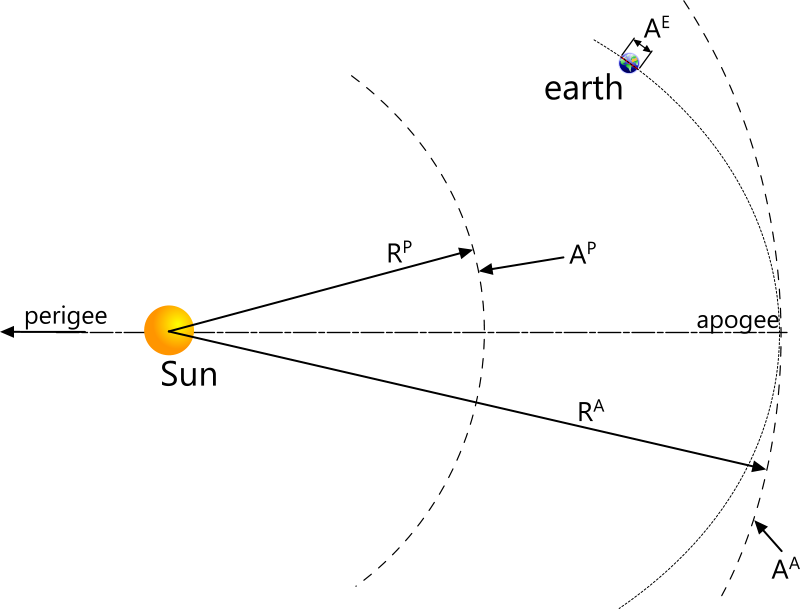
Because we know the spin-energy in both the earth and our sun, along with their surface (atmospheric) temperatures, we can use this information to establish the energy radiated and generated by our sun - including that through fission - by analytic comparison as demonstrated below.
Input Data
The information in this section is known.
Our Spin Energy
Sun: ES₁ = 1.60097718938751E+35 J (E₂)
Earth: ES₂ = 2.87701820945543E+28 J (E₂)
Orbital Radii & Areas
This Table lists the distances and areas that we can use to establish the stellar radiated heat at our extreme orbital distances; perigee (Rᴾ) and apogee (Rᴬ).
| Radius | Value (m) | Area | Value (m²) | |
|---|---|---|---|---|
| Rᴾ | 1.47095E+11 | Aᴾ | 2.71897794748441E+23 | |
| Rᴬ | 1.52094196155E+11 | Aᴬ | 2.9069338412793E+23 | |
| r₁ | 6367444.5 | A₂ | 1.27373830409936E+14 | |
| r₂ | 695710000 | A₁ | 6.0822793E+18 | |
| Orbital and body dimensions | ||||
EME radiated from the sun's surface (Eₛ) is the same at any distance in the universe. However, EME intensity decreases with increasing distance. For example, at earth's perigee and apogee;
Eᴾ = Eₛ . A₂/Aᴾ & Eᴬ = Eₛ . A₂/Aᴬ
Earth's atmosphere (including 2% water vapour)
mass: mᴱ = 5.39513197743931E+18 kg
Energy Capacity: cₚᴱ = 5.30277864707342E+21 J/K
Average Temperatures
There are two heat energy sources in our atmosphere; that supplied by the earth's internal spin-friction and that radiated by our sun.
Given that the mean relative temperature difference is 90K in winter:
perigee = northern hemisphere winter = southern hemisphere summer
apogee = northern hemisphere summer = southern hemisphere winter
Average: Ṯᴾ = 295 K (perigee) Ṯᴬ = 280 K (apogee)
Radiated: δṮᴾ = 96.2214665834975 K# (perigee) δṮᴬ = 90 K (apogee)
# iterated to ensure Eₛ
Sun's surface temperature: Ṯₛ = 5788 K
Calculations
These calculations define two solar energies based upon the above input data;
a) that radiated from its surface, and;
b) its total internal energy, including spin-friction and fission.
Stored Energy
The seasonal stored energy in the earth's atmosphere is:
perigee: Eᴾ = cₚᴱ.Ṯᴾ = 1.56431970088666E+24 J
apogee: Eᴬ = cₚᴱ.Ṯᴬ = 1.48477802118056E+24 J
Solar EME
The solar radiation proportion of the earth's seasonal atmospheric heat energy, which is based upon δṮ, is calculated thus:
perigee: Eₛᴾ = cₚᴱ.δṮᴾ = 5.10233361421404E+23 J
apogee: Eₛᴬ = cₚᴱ.δṮᴬ = 4.77250078236608E+23 J
because the sun's radiated heat does not vary with earth's orbital distance, its radiation energy should be equal for both seasons:
perigee: Eₛ = Eₛᴾ . Aᴾ/A₂ = 1.0891832323125E+33 J #
apogee: Eₛ = Eₛᴬ . Aᴬ/A₂ = 1.0891832323125E+33 J
Solar EME Intensity
The sun's EME intensity at the earth's orbital distance may be calculated thus:
Eᵢᴾ = Eₛᴾ/Aᴾ = 4.00585533737122E+09 J/m²
Eᵢᴬ = Eₛᴬ/Aᴬ = 3.74684561735044E+09 J/m²
Spin:Temperature
Given that our sun's and the earth's matter are similar (albeit in different conditions), their relative spin-friction and radiated EME should also be similar.
Because we know the atmospheric temperature of both celestial bodies, we can compare their relative spin & atmospheric energies using their respective temperatures, the ratios (η) of which should be similar:
cₚ = ES/Ṯ J/K
η = cₚ/ES /K
η = 1/Ṯ /K
Earth:
η₂ = 1/(Ṯᴾ - δṮᴾ) = 0.00503068719187041 /K
Sun:
η₁ = 1/Ṯₛ = 0.000172771250863856 /K
Ratio: η = η₂/η₁ = 0.00503068719187041 ÷ 0.000172771250863856 = 29.1176174665459
The sun's total (internal) energy is 29.12 times as much as that through spin alone. This additional energy is due to the release of fissionable energy in the sun's core.
Fission is the reason bright stars are bright.
Output Data
This section provides the calculation results.
Land & Sea
In our study of the earth's atmosphere we established that 4.00109E+24 Joules of solar EME is absorbed by the earth itself.
This therefore represents an additional solar radiation (energy) as follows:
Eₘ = 4.00109E+24 . ½.(Aᴾ+Aᴬ)/A₂ = 8.8361083773880E+33 J
Solar Radiation
The energy radiated by the sun is therefore;
1.0891832323125E+33 + 8.8361083773880E+33 = 9.9252916097005E+33 J
Total Solar Energy
total: E = ES₁.η = 4.66166413732514E+36 J
fission: EF = E - ES₁ = 4.50156641838639E+36 J
Further Reading
You will find further reading on this subject in reference publications(55, 60, 61, 62, 63 & 64)